A blog designed to reflect, redesign, and rediscover meaning
BEYOND THE SURFACE
⏱ Estimated reading time: 10 minutes
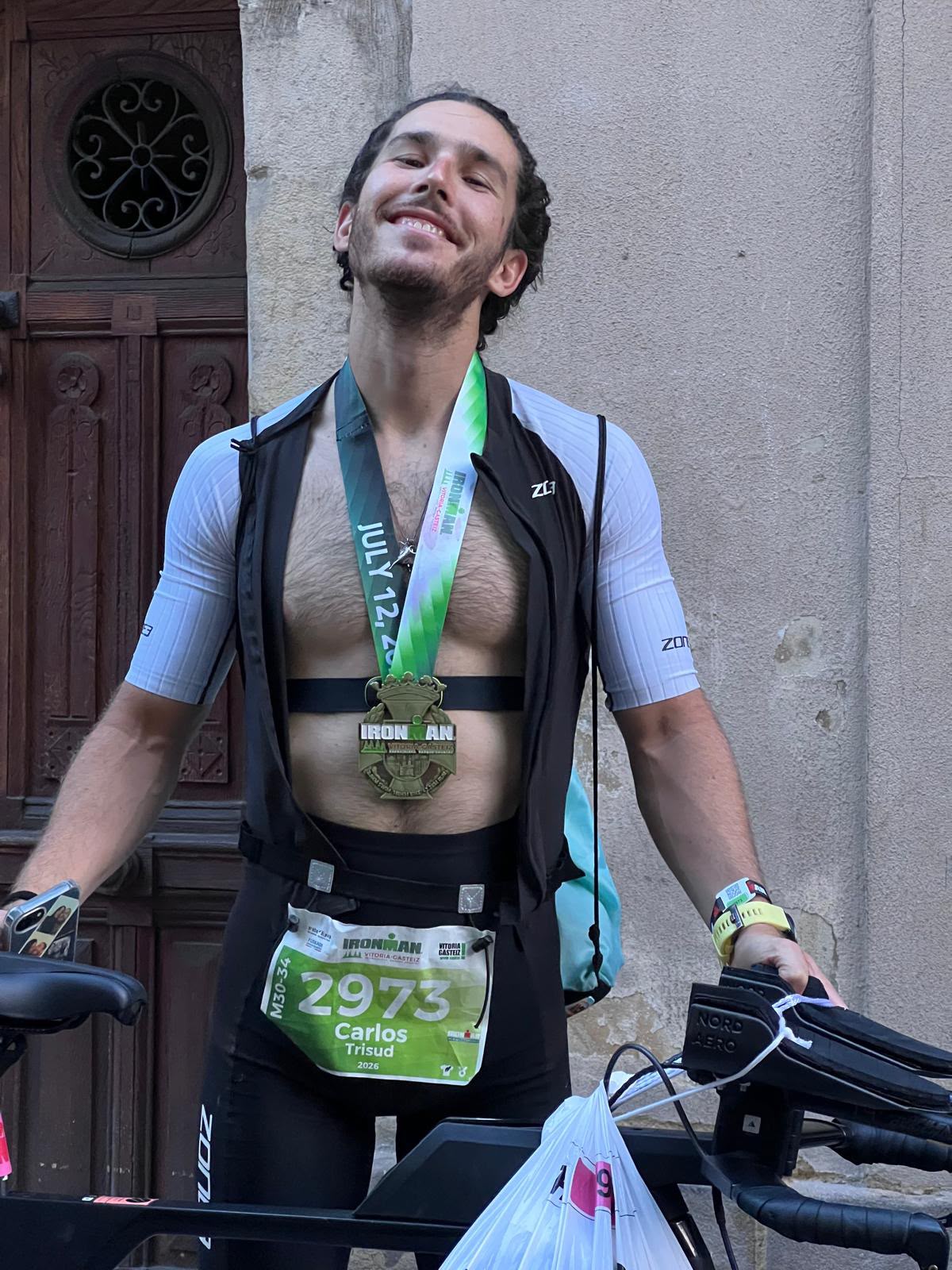
The Triumph of the Process: What My First Ironman Vitoria Taught Me About Love, Doubt, and 11:35:50
For the past year, my life has been built in the quiet, pre-dawn hours. Long before the rest of the world opened their eyes, I was out there—accumulating miles in my legs, counting strokes in the dark, and pressing down on the pedals. Today, with the finisher medal of my very first Ironman resting in my hands, I realize a profound truth: what I truly fell in love with was never just the finish line. I fell in love with the process.
It was a road paved with quiet devotion, but also with heavy, suffocating doubts. Throughout this year, there were incredibly dark, painful days. Days spent battling injuries where I honestly thought my body would break and I wouldn’t even make it to the start line. To protect myself from the crushing pressure and the fear of failure, I tried to convince my mind that this was “just another training day,” just another triathlon.
But the universe doesn’t let you hide. In the final week leading up to Vitoria, the protective shield fell away.
The Silent Passenger and the Camper Van Sanctuary
With just seven days to go, the ghosts returned. I felt that familiar, terrifying tightness in my legs—a subtle, ominous warning of the physical locking and stiffness that had derailed my training so many times over the last eighteen months. Instantly, my mind was flooded with doubt. Was my body going to betray me at the absolute worst moment? The raw, overwhelming anxiety rushed back, mirroring the exact, paralyzing nerves I felt years ago during my very first Olympic triathlon in Alicante.
But this time, I wasn’t alone, and I had a different strategy.
For five days leading up to the race, my partner and I lived in our camper van. That small home on wheels became my sanctuary, a rolling safe haven against the rising tide of pre-race panic. While the world outside was talking about paces and targets, inside the van, we built a space of quiet calm. Instead of letting the panic take over when my legs gave me that first warning of tightness, I chose to trust the plan. I managed the threat step by step:
The Taper: Resisting the urge to test my legs with panic-mileage, letting my muscles truly absorb the rest they desperately needed.
The Nutrition: Loading my system with precise hydration and clean fuel to keep my cellular energy high and ward off the lock-up.
The Mindset: Actively breathing through the fear, acknowledging the nerves as a sign that I was about to do something extraordinary, rather than a sign that my body was failing.
Those five days of slow mornings, shared glances, and quiet support in the van allowed me to transform my anxiety into focused energy. By the time I stood on the shore of Landa, the fear hadn’t disappeared—but I had learned how to carry it.
The Unforgiving Waters of Landa: 1 Hour, 26 Minutes, and 59 Seconds
Anyone who has never swum in the reservoir of Landa will never understand how a quiet, inland lake can be far more brutal and chaotic than the open sea. This Sunday, the wind transformed Landa into an absolute battleground. It whipped up relentless, short, choppy surface waves that broke our breathing patterns, clouded our vision, and stole our momentum.
The true trial began around kilometer 2 and lasted until kilometer 2.8. In that brutal stretch, the lake threw everything it had at us. The headwind was relentless, and the waves slammed directly into our faces with every single breath. It was a suffocating feeling—swimming with maximum effort, fighting the current, and looking down only to feel like we were completely frozen in place, not advancing a single centimeter.
Every stroke required a massive output of mental resilience just to keep from panicking. Surviving those waves, maintaining my composure, and finally exiting the water in 1:26:59 was my first major victory of the day.
The Wind on the Bike: 6 Hours, 17 Minutes, and 54 Seconds
Transitioning to the bike should have been a relief, but the lake had extracted a heavy toll. As I mounted my bike, I realized I was starting the segment completely dehydrated, and almost immediately, my quadriceps began to threaten me with the first ominous twinges of cramps.
The old ghosts were back instantly, screaming that my race was about to end before it had even truly begun. But instead of panicking, I chose to trust. I put my faith entirely in my nutrition and hydration protocol. I focused on taking in fluids, salts, and calories systematically. It worked. Within thirty minutes, I was able to fully salvage my quadriceps, and by the one-hour mark, I felt absolutely incredible on the bike. Thank goodness it was only a scare—a temporary crisis of acute dehydration brought on by the grueling battle in Landa reservoir.
From there, the wind refused to give us a truce. It battered us on the climbs and turned the flat, open straights of the Vitoria circuit into invisible walls of resistance, giving us “one of clay and one of sand.” But my nutrition plan was now my absolute armor for the rest of those 180 kilometers.
At every single aid station, without fail, I grabbed and finished a full bottle of water to lock down my hydration. To sustain my energy levels and protect my legs, I systematically ate energy bars, pacing my solid fuel perfectly so my stomach could process it without distress. By the time I finished my 6-hour, 17-minute, and 54-second ride, I was back in control, fueled, and ready to face the run.
Running from the Ghosts: A 3:34:33 Marathon
The run is my territory. I entered transition feeling ready, but with a silent caution. My target was highly ambitious: breaking the 3:30 barrier in the marathon. What followed was a 42-kilometer journey of pure emotion.
Vitoria is legendary for its crowds, but experiencing it as a runner is something that cannot be fully put into words. The spectators didn’t just watch; they carried us on their shoulders. The roar of the streets, the endless walls of people cheering my name, and the sheer energy of the Basque crowd literally lifted me up, making me forget the cumulative fatigue of the day.
Because the day was warming up, keeping my core body temperature down became my obsession. I relied on constant, aggressive hydration and dousing myself with water at every opportunity to keep the heat at bay. But around kilometer 21, the marathon threw its ultimate curveball: my stomach hit a wall. It was completely shut down, refusing to process any more sweet, artificial gels or liquid nutrition. Then, my brain did something entirely unexpected. It bypassed my pre-planned protocol and sent an overwhelming, primal signal:
“eat bananas.”
Never in my life would I have assumed that introducing a solid, complex carbohydrate like a banana so late in an Ironman marathon would be my saving grace. I took a leap of faith and listened to my body. Miraculously, that simple fruit settled my stomach, stopped the nausea, and provided the clean, steady fuel that kept my legs firing.
Backed by the roaring crowds and my newly stabilized stomach, I pushed through to close the marathon in 3 hours, 34 minutes, and 33 seconds. The freezing and lock-ups I had feared all year never came. There was only a steady, powerful stride carrying me home.
Choosing Celebration Over Critique: 11 Hours, 35 Minutes, 50 Seconds
As athletes, we are wired to analyze, to dissect, and to immediately look for the flaws. I know there are things I could have done better. I know where I lost seconds, where my transitions could have been sharper, or where I could have pushed a fraction harder to find those precious minutes and break the 3:30 mark.
But not today.
At 11:35:50, I crossed that finish line. Today, I refuse to look at the defects. I refuse to judge my performance or demand more of myself. Instead, I choose to feed entirely on the positive sensations of what actually happened: I completed a massive, grueling challenge that I once genuinely believed was far beyond my reach.
This is my very first completed Ironman. It is surely the first of many to come, but no matter where this sport takes me next, Vitoria will always stand as a monumental, deeply personal milestone in my history. Today is for celebrating, resting, and letting the pride of this achievement sink in.
The Heartbeat of My Race: An Unpayable Debt
If there is one absolute truth I have learned, it is this: there is no Ironman without the support of your partner.
Many people see the race day. They see the cheers, the red carpet, and a partner standing out there waiting for over eleven hours in the wind and the sun. But the reality goes infinitely deeper than those twelve hours. This finish line was built over eighteen long, demanding months.
She was there for every single second of it. She was my constant support when the doubts crept in, and she was my anchor when I felt entirely incapable of getting through this. She lived through my moments of profound fatigue, she held space for my frustration and anger, and she sat with me through the quiet loneliness of this grueling training cycle.
As I ran down the final stretch, the exhaustion of the day faded into the background. Hearing those legendary words echo through the speakers: “You are an Ironman”—and looking through the bright lights to see her waiting for me at the finish line—everything came full circle.
Without her, none of this—absolutely none of it—would have been possible. This medal is as much hers as it is mine, and sharing this journey with her has been the greatest victory of all. I will never be able to thank you enough