A blog designed to reflect, redesign, and rediscover meaning
BEYOND THE SURFACE
⏱ Estimated reading time: 9 minutes
The Power of an Anchor
How a Simple Object Can Help You Reframe Your Mind in the Moments That Matter
There are moments where everything seems to slip just slightly out of place.
Moments where doubt appears without warning and your thoughts begin to move in a direction you didn’t consciously choose. It can happen in the middle of a race, during a demanding session, before something important, or even on a normal day that suddenly doesn’t feel so normal anymore.
And when it happens, there is a very specific feeling that comes with it. A sense of losing grip.
Not knowing where to hold on.
Not knowing how to stop the spiral.
Not knowing how to reframe what is happening inside your own mind.
If you’ve ever experienced that, you’ll understand how valuable it would be to have something — anything — that brings you back. That’s where anchors begin to matter.
What Is an Anchoring Object?
An anchoring object is something simple, almost ordinary at first glance, but deeply intentional in how it is used. It is something physical that you can touch, feel, or interact with, and that, over time, becomes associated with a specific mental or emotional state.
It’s not really about the object itself. It’s about what it represents.
In coaching — and more specifically within Neuro-Linguistic Programming (NLP) — this is known as an anchor. A stimulus that becomes linked to a particular state such as calm, focus, or confidence.
That stimulus can take many forms. It might be a gesture, a word, a sound, or a physical object. What matters is the association that is built over time. Through repetition and intention, that stimulus becomes a trigger — a way to interrupt what you are feeling and redirect it.
Not perfectly. Not instantly.
But often enough to make a meaningful difference.
The Bracelet
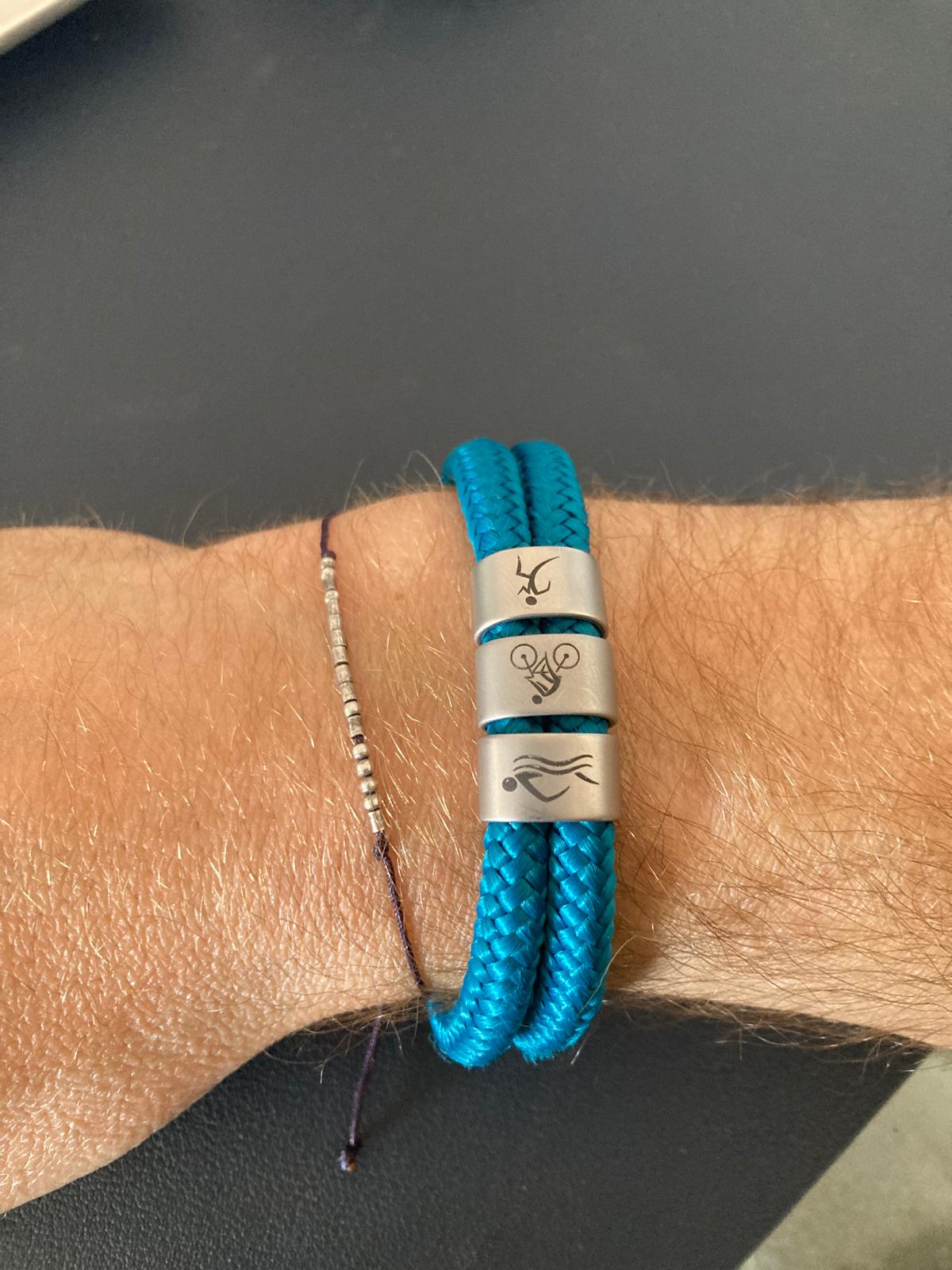
For me, that anchor is a bracelet. It’s brown, with subtle grey patterns, simple enough to go unnoticed unless you are paying attention. But if you run your fingers across it, you’ll feel something different — a sequence of raised shapes that form a pattern.
Morse code. It spells one word: Beyond.
I don’t usually look at it, and I don’t need to. Because in the moments that matter, I’m not trying to see it. I’m trying to feel it.
The Moment It Happens
There are moments during training when everything begins to shift. Fatigue builds slowly, the body starts to feel heavier, and almost without noticing, the mind begins to drift. Thoughts appear that weren’t there a few minutes before, and they begin to shape the way you experience the effort.
This is too much.
You’re not ready for this.
Maybe today is not your day.
At first, they are subtle, almost harmless. But if you don’t interrupt them, they grow. And eventually, they take over. That’s usually when I bring my hand to my wrist. I press my fingers against the bracelet and slowly trace the pattern. Dot. Line. Dot.
And something changes. Not dramatically, and not in a way that makes everything suddenly easy, but enough to create a small gap between the thought and my reaction to it. Enough to slow things down.
Enough to remind myself that I’ve been here before, that I know this feeling, and that I don’t have to follow it.
How Anchoring Works
Our brain is constantly building associations, often without us realizing it. A smell can take you back years in an instant, a song can shift your mood before you even notice it, and a place can change how you feel without any conscious effort. Anchoring works through that same mechanism, but with intention.
It creates a link between a physical stimulus — a touch, a gesture, an object — and a desired internal state. Through repetition, that connection becomes stronger, and eventually, the stimulus becomes a shortcut.
You don’t recreate the state from scratch. You access it.
How to Create Your Own Anchor
Creating an anchor is not complicated, but it does require awareness and consistency.
It starts by identifying the state you want to access more easily — whether that is calm, confidence, clarity, or control. From there, the goal is to bring yourself into that state as fully as possible, using memory, visualization, posture, and breathing to make it real. At the peak of that state, you introduce the anchor.
A gesture.
A touch.
An object.
You repeat this process over time, reinforcing the connection until it becomes something you can rely on. Not perfectly. But reliably.
Anchors in Sport and Life
In sport, this becomes especially powerful because performance is not just physical — it is deeply emotional and mental.
Anchors allow you to regulate anxiety before a race, maintain focus under pressure, interrupt negative thought patterns, and recover quickly after mistakes. They give you a way to navigate what is happening internally without needing to control every thought.
I often describe them as a point of exit and a point of return. An exit from unhelpful states. A return to useful ones. But their value goes far beyond sport. Because we don’t only need them when we are training.
We need them in conversations, in decisions, in moments of uncertainty, and in days where motivation simply isn’t there.
Beyond the Object
At some point, the bracelet stopped being just a bracelet. It became a reference. A place I could return to, not physically, but mentally. When I press it, I’m not just touching something on my wrist. I’m interrupting a pattern, shifting my attention, and reconnecting with something I’ve already practiced.
A reminder that I can move beyond what I’m feeling in that moment.
From a Coaching Perspective
This is why anchoring is used in coaching, not as a trick or a shortcut, but as a tool for awareness and emotional regulation. Because emotions will always be present. Doubt will appear, pressure will build, and uncertainty will be part of the process.
What changes everything is how we respond to those moments. Anchors don’t remove difficulty. They give you a way to navigate it. They create a pause, a reset, and a direction when things feel unstable.
We all look for something to hold onto when things don’t go as planned. Sometimes we find it by chance. Sometimes we don’t find it at all.
Anchoring is simply a way of choosing that point of stability intentionally, of creating something that allows you to come back to yourself when everything else feels uncertain. So maybe the question is not whether you have experienced those moments. You have. The question is different.
Do you already have something that brings you back when it matters most?
And if not…
Would you be willing to create one?
Because sometimes, the smallest anchors become the strongest foundations.